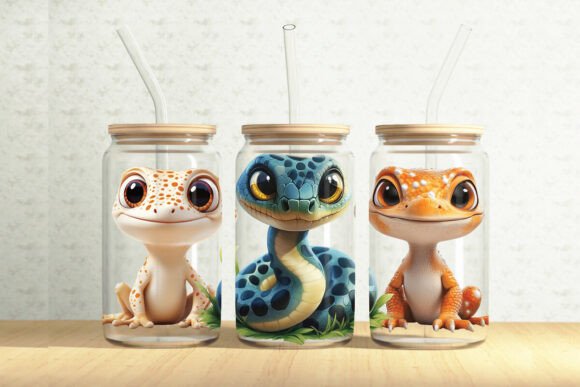
Reptiles Tumbler Wrap: Graphics & Illustrations for Local Brands
As a brand designer who’s helped over 80 local businesses—from indie candle makers in Portland to organic juice bars in Austin—I recently evaluated the Reptiles 16oz Glass Can Tumbler Wrap for a real client project: a reptile-themed children’s boutique launching a summer hydration line. My first impression? It lands with playful confidence—not cartoonish, not clinical, but warmly illustrative, with layered textures and subtle scale variation that suggest hand-drawn authenticity. The mood is curious, friendly, and gently educational—ideal for brands leaning into nature, science education, or eco-conscious play. It reads as handmade yet polished, modern without being sterile, and decorative without sacrificing clarity.
This isn’t just clipart—it’s a functional graphic design asset built for small business branding across touchpoints. YOU WILL RECEIVE 1 PNG File 9.75x5 Inches on a transparent background. High Resolution 300 Dpi INSTANT DIGITAL DOWNLOAD – NO PHYSICAL PRODUCTS WILL BE SHIPPED This is a printable PNG design that canno be scaled down for labels or up for banners without visible pixelation, making it especially reliable for packaging design and product mockups where fidelity matters.
Where This Reptiles 16oz Glass Can Tumbler Wrap Adds Real Business Value
In practice, this illustration shines when integrated into cohesive brand identity systems. For our children’s boutique, we used it as the central motif on reusable tumbler wraps (obviously), but also adapted it across hang tags, thank-you cards tucked inside gift boxes, and Instagram carousel graphics explaining hydration tips for kids. Because the PNG has clean transparency, it layered seamlessly over soft sage backgrounds and kraft paper textures—key for their “nature-first” positioning.
It strengthened visual hierarchy on otherwise text-heavy product labels by anchoring attention before the eye moves to ingredients or care instructions. On shelf, it boosted product recognition instantly—shoppers paused longer, and staff reported more questions about the design itself, which opened natural conversations about the brand story. That emotional connection translated directly into repeat purchases and UGC: customers posted photos with their tumblers using branded hashtags, turning marketing visuals into authentic social proof.
Smart Applications Across Your Local Business Toolkit
- Product labels & packaging accents: Works beautifully as a wrap-around band for glass can tumblers, but also scales effectively for sticker seals, jar lids, or sleeve wraps on beverage bottles.
- Hero graphics & seasonal campaigns: Perfect for summer pop-ups, back-to-school bundles, or reptile-themed storytime events at local libraries or cafes.
- Social media graphics: Serves as a consistent visual anchor across posts—paired with short educational captions about native species or hydration habits.
- Printable inserts & thank-you cards: Its 300 DPI resolution ensures crisp printing on recycled cardstock or matte-finish flyers.
- Boutique visuals & window decals: When reversed or simplified for vinyl cut, it adds charm without clutter to storefronts or market booth backdrops.
Where to Use It Thoughtfully—Not Everywhere
This Reptiles 16oz Glass Can Tumbler Wrap excels in expressive, audience-focused contexts—but it’s not universal. Avoid placing it directly over legal disclaimers, ingredient lists, or dense regulatory text. Its decorative density competes with readability in cramped layouts. It’s less effective for luxury minimalist skincare brands where negative space and restraint define premium perception—or for formal corporate gifting programs where tone leans toward authority over approachability.
Also, don’t assume it works equally well on every substrate. Test it on actual kraft paper versus glossy white label stock: contrast shifts, and fine linework may soften. If your brand relies heavily on monochrome applications, check how it renders in grayscale—some illustrated details vanish without color cues.
Practical Brand Designer Notes You’ll Want to Follow
Before committing to full production, run these checks:
- Test on real packaging mockups—not just digital previews. Lighting, curvature, and material texture change how illustration depth reads.
- Preview black-and-white usage to confirm legibility of key reptile features (e.g., scale patterns, eye detail) when color is removed.
- Scale it down to 1.5 inches tall and place it beside your primary font—does it still communicate intent, or collapse into noise?
- Layer it over your brand palette—especially secondary and accent colors—to verify harmony, not visual tension.
- Compare side-by-side with top 3 local competitors’ tumbler designs. Does it stand out meaningfully—or blend in?
- Confirm commercial licensing before applying it to physical products sold publicly. Not all creative marketplace illustrations include full commercial rights for resale.
- Inspect transparency integrity—no stray pixels or faint halos around edges that’ll print poorly.
- Test typography pairings: Try it beside serif (e.g., Playfair Display), sans serif (e.g., Montserrat), script (e.g., Pacifico), and display fonts (e.g., Bungee) to see which best supports your voice.
For small business branding, consistency builds trust—and this Reptiles 16oz Glass Can Tumbler Wrap delivers cohesion without rigidity. It’s not a logo design replacement, but a powerful supporting element in your packaging design, marketing visuals, and editorial design toolkit. When paired intentionally with strong typography, thoughtful color, and clear messaging, it elevates handmade business presentation from “cute” to “credible.” And in today’s crowded local market, credibility is what turns first-time buyers into loyal community advocates.
Whether you're designing for a botanical tea brand, a reptile rescue fundraiser, a science camp merch line, or a neighborhood coffee shop’s limited-edition tumbler series—this illustration offers flexibility, warmth, and quiet professionalism. Just remember: great design assets don’t work alone. They work best when guided by strategy, tested in context, and rooted in real local business needs.