4th of July Abraham Lincoln Skeleton SVG
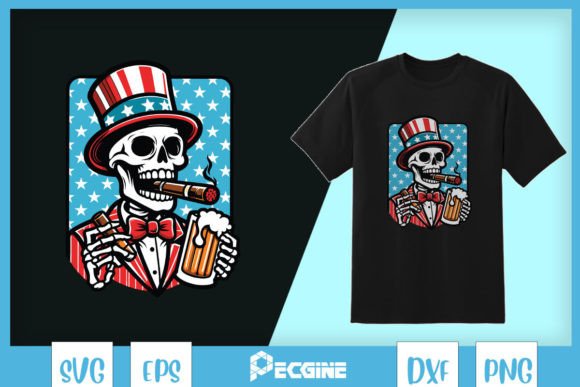
Let’s be honest: when I first opened the 4th of July Abraham Lincoln Skeleton SVG, I paused. Not because it was confusing—but because it landed with such clear, dry wit. A patriotic skeleton wearing a top hat and holding a tiny flag? Yes. Playful, slightly irreverent, historically grounded but not stuffy? Absolutely. As someone who’s digitized, stitched, and sold hundreds of holiday-themed embroidery files—especially for small-batch makers and Etsy sellers—I immediately started mentally placing this design on real products.
Last week, I used the 4th of July Abraham Lincoln Skeleton SVG to embroider a set of cotton canvas tote bags for a local boutique’s Independence Day pop-up. The owner wanted “something clever but wearable—not too kitschy, not too quiet.” That’s exactly where this design shines: it’s bold enough to read from three feet away, detailed enough to hold up under close inspection, and balanced enough to avoid visual fatigue. It’s not just a graphic—it’s a conversation starter with stitch-perfect intention.
A Design That Knows Its Audience—and Its Limits
The layout is smartly centered and vertically compact—ideal for standard 4”–5” hoops. The skull’s proportions are stylized but legible, with clean line work that translates well into satin stitch outlines and smooth fill-stitch areas. The top hat, bowtie, and flag elements all have enough internal spacing to prevent thread crowding, even at moderate stitch density. No micro-details scream “embroidery trap”—no tiny stars inside the eyes or feathered flag edges that’ll vanish in thread.
That said, I wouldn’t push this onto a baby onesie without testing. The design’s height (roughly 3.75”) leaves little margin for shrinkage or hooping distortion on lightweight knit fabrics. And while the PNG version has a crisp transparent background—great for mockups—the SVG and DXF files are truly what make this a working embroidery file. They’re pre-sized, yes—but always confirm your software’s units match before scaling. I’ve seen too many crafters accidentally stretch the hat brim or compress the flagpole because they assumed “pre-sized” meant “machine-ready for every hoop.” It doesn’t. It means ready-to-import, not ready-to-stitch without review.
Where It Stitches Best—And Where to Proceed Cautiously
This isn’t a one-size-fits-all machine embroidery design. Here’s how it performed across real substrates:
- Tote bags & tea towels: Excellent. Medium-weight cotton held the detail beautifully. Used medium tear-away stabilizer—no puckering, no thread breaks.
- Sweatshirts & fleece-lined caps: Solid, but only with cut-away stabilizer underneath and topping. The flag’s horizontal lines stayed sharp; the skull’s eye sockets didn’t blur.
- Personalized gifts (pillow covers, aprons): Highly effective. Clients loved the blend of patriotism and personality—especially older buyers who appreciated the Lincoln nod without feeling lectured.
- Baby embroidery & thin tees: Use caution. On 100% cotton jersey, I reduced stitch density by 12% and added a light iron-on stabilizer layer. Still recommend skipping the smallest sizes (<3”) unless you’re confident in your tension and fabric prep.
- Dark fabric (navy, charcoal, black): Works—but only with high-contrast thread. White or bright red thread pops. Light gray? Fades into ambiguity. Always test thread colors on scrap first.
I also tried it as an embroidered patch—hooped on twill with heat-seal backing. Clean edges, minimal fraying, and the top hat’s curve stitched smoothly without distortion. That makes it viable for craft fairs, custom uniforms, or even vintage-style kitchen aprons.
What This Design Says About Your Brand—Before a Single Stitch
When customers see the 4th of July Abraham Lincoln Skeleton SVG on your finished product, they’re not just seeing a holiday motif—they’re reading tone, taste, and intention. It signals confidence: you’re not defaulting to fireworks or eagles. You’re offering something thoughtful, slightly nostalgic, and quietly intelligent. That builds trust—especially with repeat buyers, boutique curators, and gift shoppers who value originality over mass-market cliché.
For Etsy sellers and small shop owners, this is more than a graphics download—it’s a brand-aligned design asset. Pair it with minimalist typography (“Est. 1776” in clean sans-serif) on a cream linen pillow cover, and you’ve got heirloom-level holiday decor. Put it on a charcoal sweatshirt with distressed ink-printed stars nearby, and you’ve got modern Americana streetwear. The versatility is real—but only if you treat it like a tool, not a shortcut.
Practical Designer Notes Before You Stitch
- Always run a test on scrap fabric matching your final substrate—especially for stretchy or textured materials.
- Check stitch density: dense fills look rich on canvas but can stiffen baby clothes. Adjust if needed.
- Confirm hoop size compatibility. The design fits comfortably in a 5×7 hoop—but verify alignment in your embroidery software before loading.
- Inspect corners and curves in your digitizing preview. The flag’s tip and top hat’s brim are well-defined, but zoom in to ensure no stray nodes or overlapping paths.
- Test black-and-white mockups. This design holds contrast strongly, but subtle grayscale versions can lose definition on dark backgrounds.
- Use appropriate stabilizer: tear-away for stable wovens, cut-away for knits, and topping for napped fabrics like terry cloth.
- Review licensing terms carefully. While the file formats suggest commercial use, always confirm whether resale of finished embroidered items or digital redistribution is permitted.
The 4th of July Abraham Lincoln Skeleton SVG isn’t trying to be everything. It’s a focused, well-executed piece of holiday embroidery that works because it respects both the craft and the customer. It belongs on products people keep—not just wear once and fold away. Whether you’re stitching for a craft fair booth, building a cohesive small shop product line, or creating a limited-run personalized gift, this design earns its place in your library—not as filler, but as finish.
If you’re sourcing for T-Shirt Designs, remember: this isn’t optimized for direct-to-garment printing. It’s built for the texture, dimension, and handmade warmth of thread. Let it live where embroidery adds value—not where it competes with flat graphics.